Blog post
Fast Company: Scopely COO Eunice Lee on the competitive advantage of organizations operating as software
As part of her editorial series for Fast Company's Executive Board, Scopely COO Eunice Lee shared why there is tangible value in organizations like Scopely acting like a “learning machine" and iterating and growing faster than others.
7 min read
As part of her editorial series for Fast Company's Executive Board, Scopely COO Eunice Lee shared why there is tangible value in organizations like Scopely acting like a “learning machine" and iterating and growing faster than others.
Read on Fast Company: The competitive advantage of organizations operating as software
In today’s increasingly competitive video game space, advantage rarely comes from a single breakthrough product.
Don’t get me wrong—creating an experience that feels deeply meaningful to millions of people is remarkable. But even mobile-game successes like Scopely’s MONOPOLY GO! are built over years by passionate teams dedicated to continuously improving them.
What can fuel organizational innovation and even create the “next big thing” is an internal system that can be iterated and debugged, just like software. Think of your organization as a learning machine dedicated to helping each person and team learn quicker, inform action, and take strategic risks. Because if you can learn faster—about your products, your craft, and what consumers enjoy—the little things follow.
And then the big things follow those.
WHY LEARNING IS DELIBERATE
A learning machine is not just a metaphor. It’s a deliberate, evolving framework that defines how work happens and how people thrive.
It starts with a culture of innovation deeply embedded in the DNA of a company, from its founders to its employees. Having a top-down mission of always iterating to “greatness” can inspire teams to apply lessons more quickly and get to something better than that first product— as there is always more to learn.
Defining “greatness” can be a tricky moving target. But an ongoing stated commitment to excellence ensures continuous growth as individuals and as a team. Ernest Hemingway has been quoted as saying that “true nobility is being superior to your former self.” In practice, that comes from creating the infrastructure and ecosystem that rewards high-velocity learning.
In the right environment, employees can learn from anywhere if they’re open to it. That could be a team member with an insight from a product that seems completely unrelated from the product you’re working on. Maybe the idea comes from the outside. Wherever its provenance, it’s imperative to listen, learn, and apply what you’ve learned. That’s the magic of the learning machine.
There are multiple ways a high-functioning learning machine appears in an organization.
- Maintaining dedicated rapid feedback loops with consumers and teams
- Pairing the application of data with creative intuition
- Creating platforms and opportunities intentionally to develop structure and a cadence for learning
All of that together helps compound knowledge across disciplines and teams. When it’s done right, the process itself becomes self-improving.
FIND THE FRAMEWORK
No system works without the right people. But the inverse is also true: Even the best people are limited by the systems they operate within.
A strong operating system that offers frameworks around culture and processes unlocks talent. It creates an environment where individuals can do things they simply couldn’t do elsewhere.
A key component of this is empowering teams with ownership. By giving team members meaningful autonomy to make decisions while providing the resources and support to succeed, trust and accountability become part of the culture. They aren’t treated as just corporate buzzwords, but as lived experiences.
It’s also critical to build intentionally around cross-functionality. In environments where teams have visibility and insight into others’ work—whether that take place in all-hands meetings, scheduled check-ins, or informal conversations—ideas spark. Team members lean in. Silos and walls come down. The entire ecosystem becomes an atmosphere more conducive to sharing insights and growing together.
THE WORK IS NEVER DONE
As organizations grow, complexity increases. That’s why a learning, machine-style operating system must be treated as a living product. You must invest in it, refine it, and always challenge it. Just like any great software system, it requires ongoing evolution to remain effective. Aim to “fix the bugs” to create a high-functioning ecosystem built to scale.
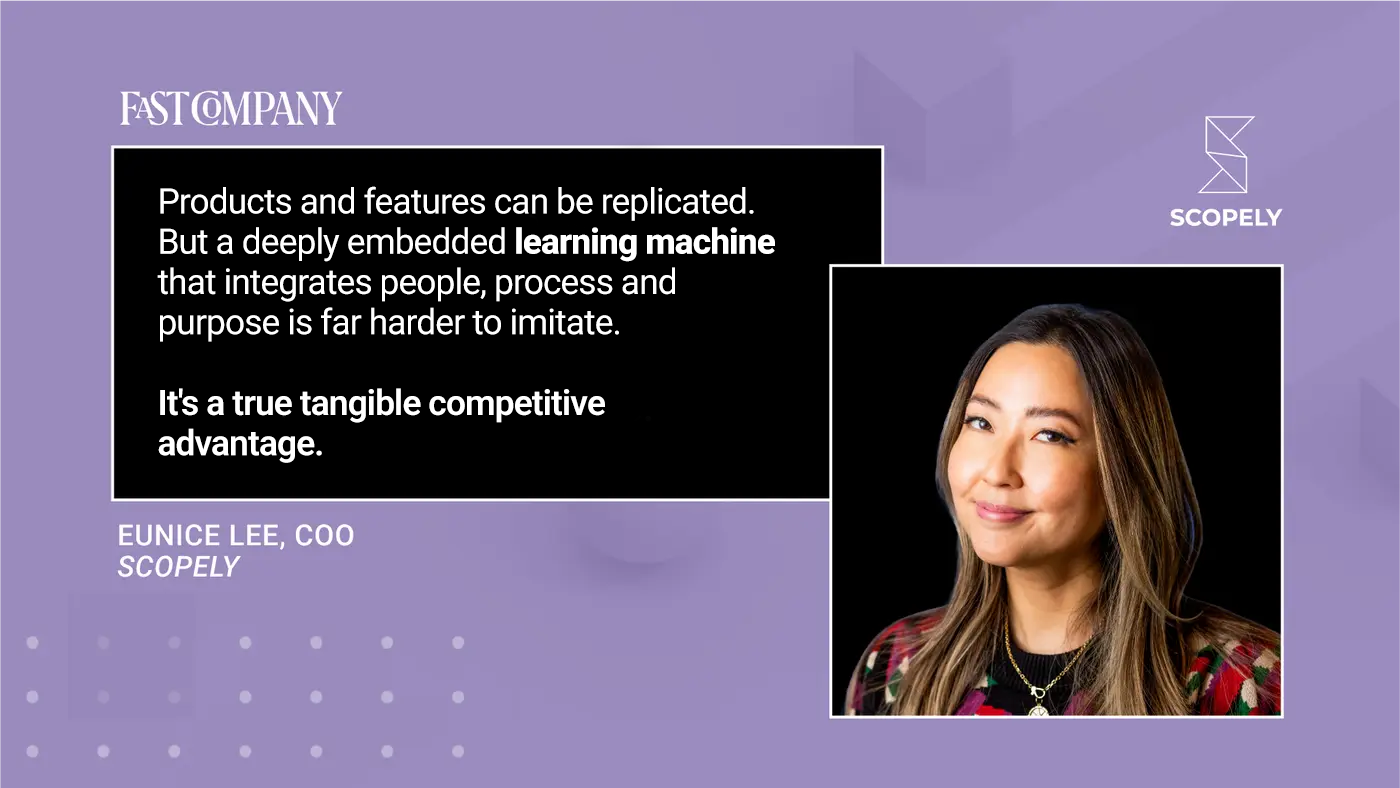
Products and features can be replicated, and business models can be reverse engineered. But a deeply embedded learning machine that integrates people, process, and purpose is far harder to imitate. It’s a true tangible competitive advantage.
In a landscape defined by constant change and newcomers, those who succeed won’t just build the best products. They’ll build superior systems for better products, systems that help them learn and adapt faster, and adapt and improve consistently.
Simply put, the best organizations run like software and upgrade just as often.